


 5 Min
5 Min In OTC

Follow this topic

Bookmark

Record learning outcomes
Being one of the highest consumers of ultra-processed foods in Europe, the UK public is not faring well when it comes to nutrition. “Around two thirds of the population are either overweight or living with obesity, according to the 2022 Health Survey for England,” says Clare Thornton-Wood, a registered dietitian and British Dietetic Association spokesperson.
The 2025 National Diet and Nutrition Survey also found that less than a third of UK adults consume the recommended five portions of fruit and vegetables a day, but they do eat more sugar, saturated fat and salt than recommended. The vast majority also consume less dietary fibre than they should. “Only four per cent meet the requirement of 28g per day,” adds Clare.
The survey also found that key nutrients including folate, iodine and vitamin D were low across people’s diets.
Vitamins and minerals such as these are important nutrients that enable the body to function and support vital systems, such as the immune and nervous systems, and bone health. When the body’s levels are too low or too high, it can cause long-lasting issues.
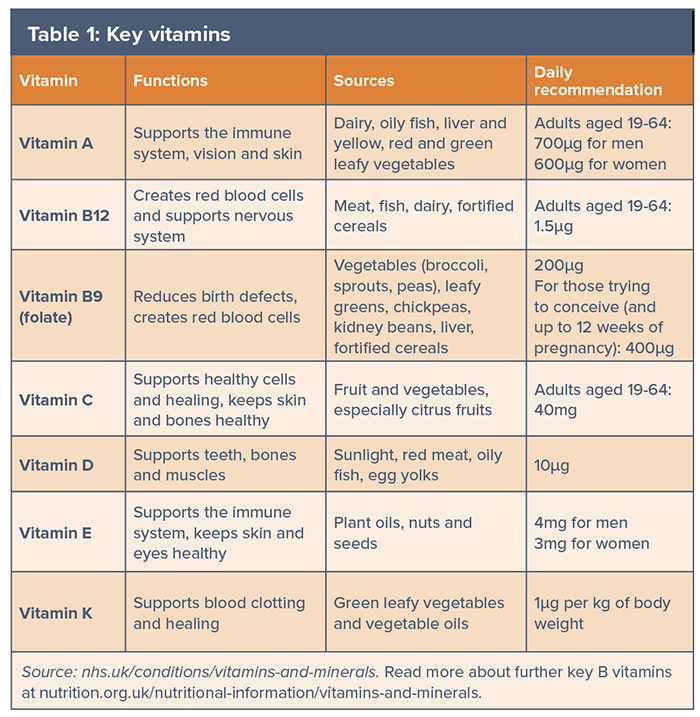
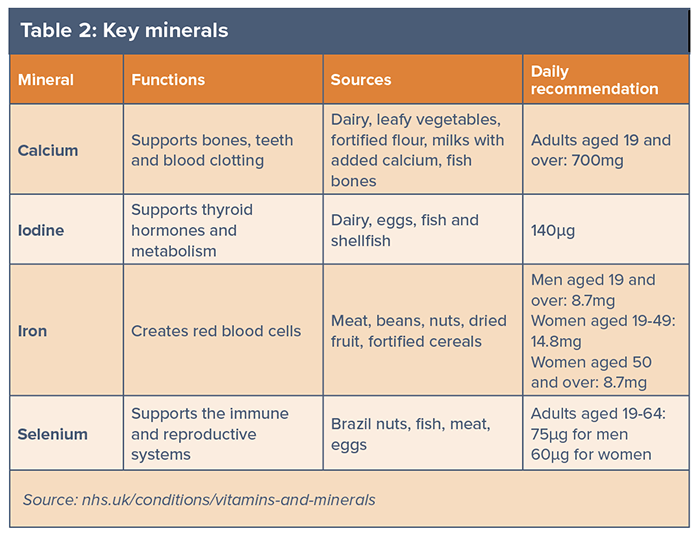
Pharmacy teams should ensure they have a good understanding of the key vitamins and minerals, their functions in the body and foods they are commonly found in (see Tables 1 and 2).
A growing market
It is recommended that people consume a well-balanced, varied and nutritionally dense diet first and foremost. However, food supplements are a popular way of supplementing dietary intake.
In recent years, there has been growing use of food supplements to support chronic illness and deficiencies and as a preventative health measure. The UK food supplements market was valued at £3.8 billion in 2023 and is projected to grow at a compound annual growth rate of 6.2 per cent until 2030, according to the Worldmetrics Food and Nutrition Report 2026. This report also found that 42 per cent of UK adults take at least one supplement regularly, with women more likely to take supplements than men (47 per cent and 37 per cent respectively).
“42 per cent of UK adults take at least one supplement regularly”
Deficiencies
If a customer expresses an interest in dietary supplements, or a pharmacy team member suspects a customer has nutritional deficiency, it is always advisable that they are referred to the pharmacist. “Many of the signs of deficiency are similar for various deficiencies, so should be discussed with a suitably trained healthcare professional such as a pharmacist, registered dietitian or GP,” explains Clare. “Common signs of deficiency include tiredness, pale skin, and heart palpitations.”
Spotting such signs and being aware of a customer’s individual circumstance can help lead to key conversations and appropriate referrals. “It is particularly useful to ask about calcium intake if someone has had a broken bone after a minor bump or fall, or is concerned about their bone health, has a restricted diet or does not eat dairy products,” say Erika Radford, Julia Thomson and Kirsty Carne from The Royal Osteoporosis Society. “Calcium intake may also be relevant for people with conditions that affect how the body absorbs calcium, or those taking medicines that can affect bone health.”
Menopause and nutrition
Changes in oestrogen levels during the menopause can trigger a myriad of symptoms, but most worrying is how it impacts bone health. “Oestrogen helps to maintain bone density. When oestrogen levels fall during menopause, bone loss speeds up,” explains Erika Radford, head of information and support services, Julia Thomson and Kirsty Carne, helpline managers and specialist osteoporosis nurses at The Royal Osteoporosis Society (ROS). “This can increase the chance of osteoporosis and broken bones, particularly in women who go through menopause at a younger age.” So what can we recommend? “Pharmacy teams can ask about a person’s usual diet and suggest calcium-rich foods where needed [see Table 2]. If someone cannot get enough calcium from their diet, their doctor may recommend or prescribe a calcium supplement,” say Erika, Julia and Kirsty. “Menopause is also a good time to talk about other ways to look after bone health, including getting enough vitamin D, taking regular strength and impact exercise, not smoking and not drinking too much alcohol.”
The ROS is celebrating World Osteoporosis Day on 20 October with a key focus on Menopause. Find out how pharmacy teams can get involved at: theros.org.uk.
Look out for more information on menopause and bone health in the November issue of Training Matters.
Red flags
Nutritional deficiencies can be hard to spot. However, Emily Angus, senior registered dietitian at The Vegan Society, highlights some of the more common signs:
- Persistent tiredness or weakness
- Difficulty concentrating
- Feeling short of breath
- Pale skin
- Unexplained hair loss
- Poor wound healing
- Frequent illness
- Unintended weight loss
- Changes in appetite
- Tingling, numbness or altered sensation
- A sore or inflamed tongue.
Anyone exhibiting these symptoms should be referred to a GP. “These symptoms can also be related to a variety of medical conditions and may not have a nutrition-related cause,” Emily explains. “Vitamin B12 deficiency is particularly important to identify and treat because it can cause progressive neurological problems such as numbness and tingling in the limbs, changes in memory, mood and concentration, and anaemia. These effects are generally reversible if the deficiency is caught early, but if left untreated can become irreversible.”
“Many of the signs of deficiency are similar for various deficiencies”

Pharmacy advice
As well as having a good understanding of the key vitamins and minerals required by the body to maintain normal health, pharmacy teams should be able to offer self-care and healthy living advice in their customer conversations. The Government’s Eat Well Guide is a great resource that shows what a well-balanced and varied diet can look like. It is available to suit a variety of different cultural preferences. Erika, Julia and Kirsty also recommend the following lifestyle tips that pharmacy teams can pass on to customers:
- Take regular exercise, including strength and impact exercise
- Avoid smoking
- Do not drink more than the recommended amount of alcohol
- Take steps to reduce the chance of falls.
“It is possible to meet the body’s iodine and calcium needs by drinking 500ml of a sufficiently fortified plant milk each day”
Market Monitor: Product update from Training Matters
New Pro Plus Fizz Immune Support has been formulated to give the concentration and alertness boost expected from Pro Plus, with added immune support in a tasty and convenient effervescent format. It blends 75mg caffeine per tablet to help increase alertness with 18 other nutrients including vitamins A, C, D, Zinc, which contribute to the normal function of the immune system, vitamins B6, B12 and iron to help reduce tiredness and fatigue and support normal energy-yielding metabolism. “Pro Plus Fizz Immune Support delivers daily support for alertness, immunity and energy, making it the ideal companion for busy, active lifestyles,” says manufacturer Lanes Health.
proplus.co.uk
Overconsumption
Just as it is possible for a person to be deficient in certain vitamins and minerals, it is also possible to consume too many, and this can have negative health impacts.
“Fat-soluble vitamins (A, D, E, K) are particularly problematic in excess as the body stores excess in fat tissue and the liver rather than flushing it out in urine like water-soluble vitamins (B, C),” explains Clare. “The amounts build up over time and toxicity is more likely with regular high-dose supplementing. The water soluble vitamins can generally be excreted in urine, but may result in short-term symptoms like diarrhoea.”
Overconsumption comes from taking too high a dose of a particular vitamin through supplementation. “For instance, taking a multivitamin and also a separate single or combined vitamin,” says Clare. “It is very uncommon for toxicity to occur with food, but care should be taken with fortified foods, such as dairy products fortified with vitamin D, as if they are eaten in sufficient quantities and combined with supplementation, this could be an issue.” Visit The British Nutrition foundation nutrition.org.uk to find out more.
Plant-based diets
People may choose to follow a plant-based diet for multiple reasons, including animal welfare, environmental or health concerns. A vegetarian diet excludes meat, whereas a vegan diet removes any product that comes from an animal, so this includes meat as well as foods such as eggs and dairy produce.
Research it well
As meat and animal by-products such as a dairy contain key nutrients required by the body for good health, it is important that those following vegetarian and vegan diets do not simply cut them out. Instead, it’s important to find alternative sources.
This can be done by following a well-researched diet, and food supplements can play a part too. “People like to claim that you need a lot of supplements to make sure you meet your nutritional needs on a vegan diet, but it’s far from true,” says Emily Angus, senior registered dietitian at The Vegan Society. “As dietitians at The Vegan Society, we emphasise that supplements should be used selectively to complement a balanced and varied plant-based diet.”
Emily highlights four nutrients that vegans especially should pay attention to: B12, vitamin D, iodine and selenium. “These nutrients are less abundant or, in the case of vitamin B12, not found naturally in plant foods,” she explains. “This means that the most reliable way to obtain them is by taking a micronutrient supplement and/or regular consumption of fortified foods.”
Vitamin B12 stores can take many years to deplete, so symptoms can appear late, says Clare Thornton-Wood, registered dietitian and British Dietetic Association spokesperson. Clare warns that deficiency risk is serious, and can lead to fatigue, nerve damage and anaemia.
Key focus
For vitamin B12, Emily recommends a daily supplement containing at least 10mcg. “Vitamin B12 can be found in some fortified foods, such as nutritional yeast, plant-based dairy alternatives, fortified cereals and yeast extract spreads. However, in order to meet their daily needs, a person would have to consume these foods two to three times a day, every day, three to four hours apart. With this in mind, the most appropriate route for most people is likely to take a daily supplement.”
Many ‘fortified’ plant-based alternatives for dairy now provide a good option for those following a plant-based diet. “It is possible to meet the body’s iodine and calcium needs by drinking 500ml of a sufficiently fortified plant milk each day, and some people may prefer to do this rather than take an iodine supplement. If they do choose this route, look for a product containing at least 25mcg per 100ml,” says Emily.
“Selenium can actually be found in a few plant foods. Brazil nuts are the best source, and eating a couple of these each day can be sufficient if you choose not to
take a selenium supplement. Other foods such as mushrooms, sunflower seeds, sesame seeds and brown rice can also provide selenium but amounts vary depending on the nutrient richness of the soil in which they are grown.”
Signposting
For more information, pharmacy teams can direct customers to:
- An NHS dietitians referral via their GP
- The Vegan Society website: vegansociety.com
- The British Dietetic Association’s directory of private dietitians at bda.uk.com.

Share:


In OTC